
















5 Strategies for Scaling VOIP Systems for Businesses

Since its first introduction in 1995, VoIP (Voice over Internet Protocol) has received growing adoption by businesses and even home users. Research has shown that the VoIP market can reach a projected value of nearly USD 355 billion by 2032. Various users highly appreciate VoIP for its cost-effectiveness, convenience, and more importantly, scalability. But is scaling VoIP systems for businesses that simple? You’ll find the answer in this article.
Here, we’ll cover:
- Benefits of VoIP scaling for your business;
- Challenges in VoIP scaling for your business;
- Considerations before VoIP scaling;
- 5 detailed strategies to scale up your VoIP system seamlessly.
So, are you ready? Keep reading!
Understanding VoIP Scaling
What is VoIP Scaling?

Like any software, VoIP systems can be scalable as your business evolves.
So, what is VoIP scalability? Generally, this is the process of modifying and expanding your VoIP system to meet your ever-changing demands (e.g., higher call volumes or additional features like advanced security).
Scaling the system can handle these needs while ensuring call quality or network performance. This process might include upgrading the hardware, improving software, or using cloud services to manage larger amounts of data and calls.
Compared to traditional landlines, VoIP allows you to scale more easily. Imagine you start a small business with just a few employees, hence only needing a few phone lines. But when your business grows and hires more people, you’ll need more lines to accommodate everyone.
Landlines require a more complex and expensive setup because of the physical infrastructure involved. This involves digging trenches to lay more cables, connecting these cables to your business, and more. Meanwhile, using existing internet infrastructure, you can add or remove lines easily without new, cost firmware.
Why Scaling Matters for Growing Businesses

Scaling is essential to any growing business for some reasons:
- Meet Increasing Communication Needs: When your business grows, the communication needs of your team also increase accordingly. As such, they need to interact with more employees, partners, and clients.
- Process Higher Call Volumes: While your existing VoIP system only accommodates some incoming and outgoing calls at once, scaling will handle higher call volumes. This helps your VoIP system avoid communication delays, run smoothly, and ensure good call quality.
- Foster Efficiency & Reliability: As already mentioned, a scalable VoIP system ensures that communication stays consistent even during peak times. This improves your VoIP network’s reliability.
- Enable Cost-Effectiveness In the Long Run: Many argue that a scalable VoIP system can initially cost more than a traditional phone system. But in the long run, it proves more cost-efficient. Instead of changing the system whenever your business expands, VoIP scaling allows you to upgrade the system without significant extra expenses.
- Improve Customer Experience: As scaling handles many calls quickly and seamlessly, your customers feel happy. Further, a scalable VoIP system offers more advanced features like voicemail, call forwarding, call routing, and call analytics. These features ensure that your customers can always reach the right person, regardless of their location or time zone. This will lead to better service, which then builds trust and loyalty. For any growing business, this is crucial to long-term success.
Key Challenges in Scaling VoIP Systems
Despite its potential benefits, scaling VoIP systems still poses some challenges. Understanding the following problems will better equip your VoIP scaling plan:
Bandwidth Management
As the number of calls increases, much more bandwidth is required to meet your growing demands. The minimum requirement for bandwidth depends on many factors, like the number of concurrent calls, expected call quality, or the type of VoIP systems (cloud-based or on-premises).
However, each VoIP call needs from 85 kbps (kilobits per second) to 100 kbps for both upload and download speeds. Consult your VoIP service provider to know how much bandwidth you need at least per call to optimize performance.
To increase bandwidth, you need to upgrade your internet infrastructure. This might involve switching to a faster internet plan or upgrading your router/modem.
Hardware & Software Licenses for Scaling VoIP Systems
Scaling VoIP systems for growing businesses requires licenses to use specific hardware or software. In other words, your business needs to purchase additional licenses when adding more users or features.
For example, Avaya requires all non-subscription systems to buy Avaya IP Endpoint licenses for Avaya SIP desk phones, user licenses for Avaya SIP softphone apps, and 3rd Party IP Endpoint licenses for third-party SIP telephones & extensions.
When you purchase these licenses for on-premises systems, you may have to add more hardware (e.g., IP phones, routers, or gateways). Meanwhile, cloud-based systems need minimal hardware as the cloud often handles most of the infrastructure.
Impact on Existing Integrations
Scaling can affect the integration of your VoIP network with existing systems like CRM (Customer Relationship Management) and communication apps. This is because changes to VoIP infrastructure or features can make them less compatible.
To address this issue, you need to assess how these changes may impact existing integrations. Then, upgrade or reconfigure third-party systems to make everything work seamlessly as your VoIP system scales. If needed, consider leveraging APIs to ensure integrations become more flexible.
5 Strategies for Scaling VoIP Systems for Businesses
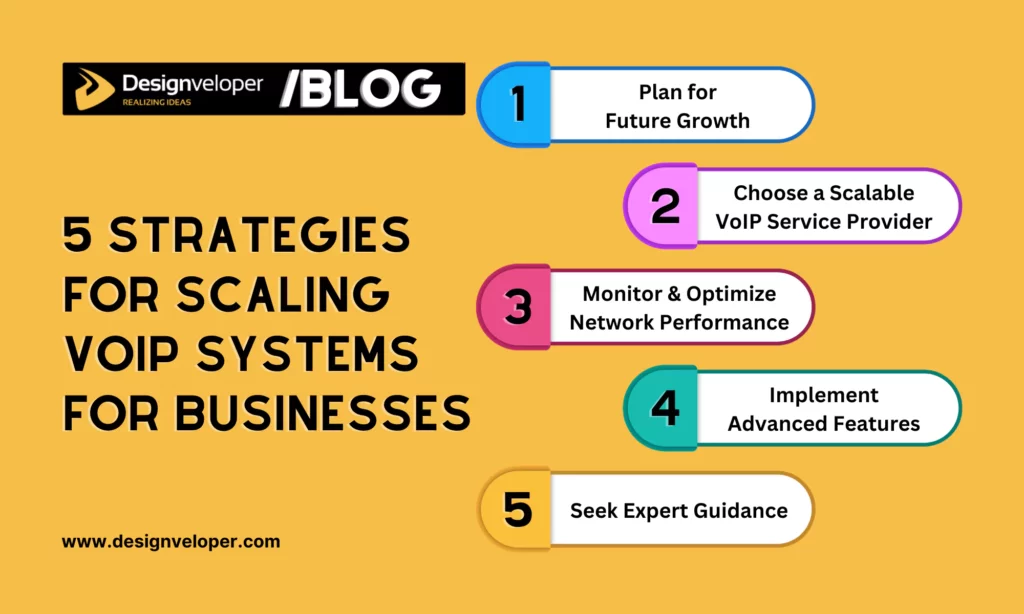
With its dependence on the Internet, scaling VoIP systems becomes easier and more convenient for businesses. However, this doesn’t mean all can scale their systems up effectively without the right and careful strategies. Here, we’ll elaborate on the top five tactics you should consider for seamless VoIP scaling:
1. Plan for Future Growth
To ensure your VoIP system can handle your business’s growth, it’s crucial to anticipate your future communication needs. Consider factors like:
- Expected increase in employees: More employees mean more calls and communication.
- Forecast growth in customer base: A larger customer base often increases call volume.
- Expansion plans: If you plan to open new branches or provide new services, predict possibly additional communication needs.
Plus, don’t forget to include a robust disaster recovery plan when preparing for your business’s future growth. Even the best systems can confront outages or disruptions. So, devising a recovery plan ensures that your VoIP system still works well during these times. Consider backup solutions, redundant systems for minimizing downtime, and a business continuity plan for keeping the system operational.
2. Choose a Scalable VoIP Service Provider
The next strategy is choosing a scalable VoIP provider that aligns with your specific requirements. Here are some factors you should consider to find the right partner:
Flexibility
Evaluate whether the VoIP provider offers cloud-based or on-premises systems. Then, consider which one better suits your business needs and future growth plans. Further, several providers offer more flexible user packages for business growth. So, check whether the provider enables unlimited extensions or adds a charge per user.
Reliability & Performance
Consider a provider that has a high uptime record (99.9% or higher) to minimize disruptions. Also, assess their call quality through factors like clarity, latency, and jitter. Finally, ensure the provider has a robust network infrastructure that can handle increasing call volume. All these factors will give you an in-depth insight into the provider’s network performance and reliability.
Features
Ensure the provider offers core VoIP features like calling or voicemail. Check whether the provider offers advanced features that can benefit your business needs not only at the moment but also in the future. These advanced features might involve call recording, call center capabilities, or call analytics.
Plus, consider whether the provider has scalability features like auto-attendants, call queues, and user management.
In particular, auto-attendants automatically direct calls to the right agent or department. Call queues can effectively monitor incoming calls, especially at busy times while user management helps you easily add or remove users according to your changing needs. All these features manage high call volumes and keep everything running smoothly as your business evolves. This will save a lot of time and costs for upgrading the system later on.
Security and Compliance
Ensure your chosen provider uses strong security measures like encryption to safeguard your data. It’s also crucial to verify the provider’s compliance at scale with your specific industry’s regulations and and standards like HIPAA.
Cost Structure
Scaling VoIP systems for businesses is an ongoing process. So, you should choose a provider with a pricing model that grows with your business.
Validate which costs you may cover for a scalable VoIP system. They might be upfront costs, recurring fees, and any additional charges. We advise you to choose tiered pricing or pay-as-you-go instead of fixed pricing as these models are more budget-friendly for scaling.
Don’t forget to ask about any hidden fees for upgrading services, adding users, and more.
Customer Support
Nothing can ensure your scalable VoIP system always works as expected. So, receiving immediate customer support from a provider is a must to help you address any technical issues. Assess how available the provider’s customer support is, including response times and channels. In addition, evaluate the provider’s technical expertise and ability to handle your specific needs.
Future Outlook
Another factor you might consider is a provider’s future outlook. This involves how stable their financial conditions are and how viable their long-term vision is. Also, consider their commitment to innovation and ability to adapt to future trends. This ensures that your VoIP system will be scaled with the latest technology.
3. Monitor and Optimize Network Performance
Once you’ve launched the VoIP system, it’s time to monitor its performance. This ensures that the system operates seamlessly as more users and calls are added. Your business needs to assess certain metrics to detect possible issues early and take proactive action to optimize performance.
These metrics include:
- Bandwidth usage: Track how much bandwidth VoIP traffic and other apps are using.
- Latency: Measure how much time it takes for data packets to travel between devices on your network. High latency can result in poor call quality and interruptions.
- Packet loss: Manage the rate at which data packets are lost during transmission. This can impact call quality.
- Jitter: Evaluate delays in data packets.
You may leverage a variety of tools to monitor these key metrics. Such software as Wireshark, SolarWinds, or PRTG gives you a comprehensive view of network performance. They also provide specific metrics to measure call quality and performance. These tools can be built-in parts of VoIP systems or offered by third-party monitoring services.
When you detect potential issues, optimize your network performance. This can include modifying network settings like Quality of Service (QoS), upgrading hardware (e.g., switches or routers), and enhancing network layout. Regularly monitoring and optimizing network performance keeps your VoIP VoIP reliable and efficient when your business scales.
4. Implement Advanced Features
Core features are essential for any VoIP system. But only using them isn’t enough to efficiently scale your VoIP system when your business grows. This is because managing increasing communication needs becomes more complex. Leveraging advanced features can allow your VoIP system to adapt to your business needs. For example, call queues can handle multiple calls at once during peak times. So the system can deal with the growing number of calls quickly and easily.
Further, these advanced features may automate tasks and provide meaningful insights into call performance. This allows your team to optimize calls and enhance customer experience even when your business expands.
To implement advanced features, configure and customize them to fit your specific needs. Plus, train your team on how to use these features effectively. Don’t forget to regularly assess their impact on your business communication and make essential adjustments.
5. Seek Expert Guidance
If you don’t have a strong understanding of VoIP or time with resources to research scaling strategies yourself, look for expert guidance. This may be a worthwhile investment for some reasons:
- Tailored Advice: VoIP experts can evaluate your specific business needs, communication patterns, and growth plans. Based on this understanding and expertise, they can recommend VoIP systems, strategies, and features that match your requirements.
- Issue Troubleshooting: VoIP professionals can use their expertise to identify and address technical problems. This ensures your system works smoothly. Further, they can suggest appropriate strategies to enhance call quality, mitigate latency, and improve overall network performance.
- Updates With Industry Trends: VoIP experts stay ahead of the latest industry trends, tech, and best practices. Their guidance can help you make informed decisions about new features and system upgrades.
- Risk Reduction: Expert advice prevents you from common mistakes or challenges related to VoIP scaling. VoIP professionals can even detect possible risks and give suitable recommendations to minimize them. This ensures a seamless scaling process.
- Cost-Effective Solutions: Experts can recommend cost-effective solutions to optimize your investment and maximize ROI. They also help you avoid spending money on unnecessary features or upgrades.
By consulting with VoIP professionals, you ultimately save many resources and achieve the best possible outcome.
How Designveloper Can Help With Scaling VoIP Systems for Your Business

Throughout this article, we expect you to have a strong understanding of scaling VoIP systems for businesses. VoIP scaling is generally beneficial to your increasing communication needs. But there are still several challenges revolving around scaling like bandwidth management or hardware/software licenses. Without proactive planning, the right VoIP provider, and careful strategies, you hardly build a scalable VoIP system that meets your growing demands.
If you’re looking for expert guidance for customizing a scalable VoIP solution, Designveloper will be your trusted partner! With our in-depth expertise & years of experience, Designveloper uses cutting-edge technology to craft bespoke VoIP solutions that matches your specific requirements.
Be it for remote workers, customer service, or any purpose, our tailored apps enhance user experience and streamline business communication. They come with necessary features like seamless integration with your existing infrastructure, IVR (Interactive Voice Response), and virtual extensions. These features enable seamless communication for your business.
Trust Designveloper to build a VoIP app that enhances communication efficiency and productivity for your organization.
So why wait? Contact Designveloper today and discuss your idea!
Also published on

Share post on










Related Articles



Advanced Configuration in Kamailio: A Comprehensive Guide
Advanced Configuration in Kamailio: A Comprehensive Guide Published April 24, 2026
Kamailio vs. OpenSIPS: Differences & How to Choose One
Kamailio vs. OpenSIPS: Differences & How to Choose One Published April 24, 2026
The process of integrating a SIP softphone with Asterisk server
The process of integrating a SIP softphone with Asterisk server Published April 24, 2026