


















Most teams don’t struggle with understanding Agile in theory, but with seeing what it actually looks like in practice. Today, you can read definitions everywhere. But without a clear agile methodology sample, Agile still feels a bit confusing, especially for new Agile adopters. And that can lead to project failure.
So, if you’re tired of theories and want to see how companies are adopting Agile in practice, don’t skip this article. Here, we’ll show you the most common Agile frameworks, then detail a step-by-step Agile project sample. Further, we’ll provide practical Agile methodology examples and a few success stories, along with some tips to adopt Agile more effectively.
Keep reading!
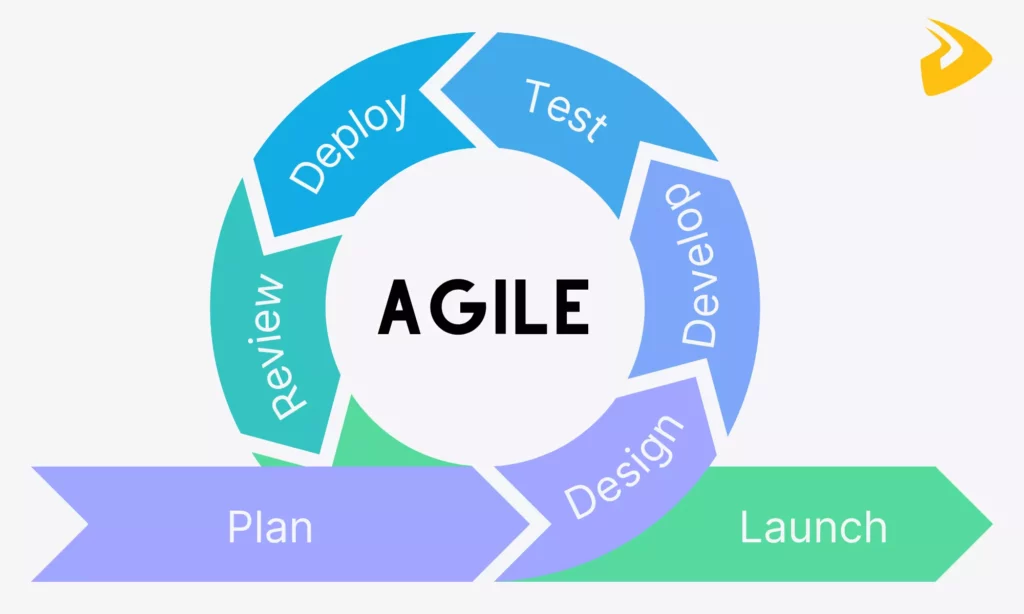
The Top 10 Most Used Agile Methodologies
Agile isn’t a single methodology. Instead, it’s an umbrella term that includes lots of approaches you can adapt depending on goals, team size, and preferred working styles. Below are common Agile methodologies to consider:
- Scrum: The most widely used Agile framework. It requires your team to break work down into short sprints (usually 2-4 weeks), with defined roles like Product Owner and Scrum Master who keep projects on track.
- Kanban: Helps visualize work by using boards and limiting work in progress. It doesn’t aim to enforce strict deadlines, but tries to maintain a continuous workflow instead.
- Lean: Originates from the Toyota Production System. This approach focuses on reducing waste and delivering the most crucial features to optimize resources and speed up delivery.
- Extreme Programming (XP): A bit more engineering-focused. XP accordingly covers practices like pair programming, frequent releases, and constant feedback to improve code quality.
- Crystal: A people-centric umbrella framework you can tailor based on team size and the project’s importance. It emphasizes team communication, collaboration, and frequent release.
- Feature-Driven Development (FDD): Organizes work to build specific features. Particularly, your team plans, develops, and delivers the small, manageable features of a complex system incrementally.
- Agile Data: Uses Agile practices to manage, model, and analyze data within Agile teams. Accordingly, it encourages incremental delivery instead of planning everything upfront, helping teams to respond quickly to evolving needs.
- Dynamic Systems Development Method (DSDM): Focuses on adjusting the scope flexibly to deliver projects on time and on budget. It emphasizes active user involvement, iterative development, and frequent delivery, often used in enterprise settings.
- Scaled Agile Framework (SAFe): Designed for large organizations. SAFe coordinates many Agile teams working on the same product through layered planning and alignment.
- LeSS (Large-Scale Scrum): Extends Scrum principles to many teams but tries to keep things simple.
FURTHER READING: |
1. How to Build an Application Like ChatGPT: A Full Guide |
2. Can ChatGPT Really Build an App? What ChatGPT Can & Cannot Do |
3. What Is Mocha in Javascript? A Complete Beginner’s Guide |
A Step-By-Step Agile Project Sample
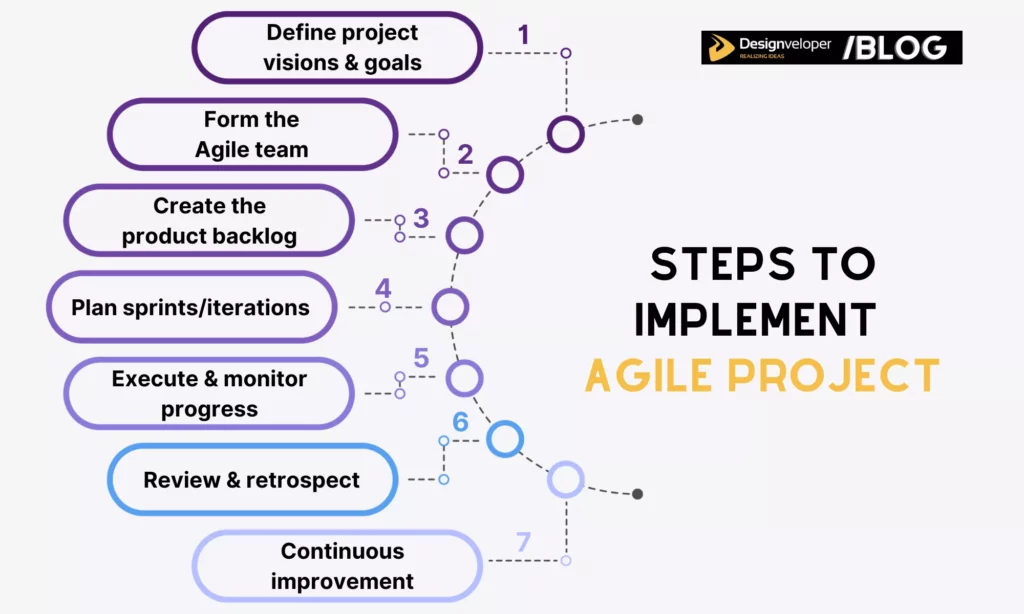
So, we’ve looked at the most common Agile frameworks. And you now may wonder: How does an Agile project actually take place from start to finish? Below is a step-by-step Agile methodology sample that guides you to execute Agile projects successfully in practice:
Step 1: Define Project Vision & Goals
This step is very important, regardless of Agile frameworks and practices. Without a clear vision, your team can end up building features that seem useful but don’t really move the product forward. In Agile, where things evolve quickly, that lack of direction can lead to project failure faster.
So, how can you identify a strong project vision? Ask these questions:
- Who are you building for?
- What problem are you solving?
- What success metrics or acceptance criteria does your team use to evaluate the effectiveness of Agile and the product?
You don’t need a 20-page document, but concise answers that everyone agrees upon.
Besides, when defining goals, try to keep them measurable and flexible. For example, instead of saying “improve user experience,” you might say “reduce onboarding time by 30%.” This SMART goal gives your team something concrete to aim for. And you should review project goals regularly to keep everyone aligned, especially when priorities and demands change.
Step 2: Form The Agile Team
Frameworks and goals can’t guarantee success without the right people. A well-formed Agile team not only includes all the skills needed but also collaborates well toward the shared goals.
Accordingly, to form the right Agile team, you need to clarify roles and responsibilities – or in other words, define who does what. For example, a Product Owner defines and prioritizes the product backlog, while a Scrum Master coaches the team on Agile principles and facilitates Agile ceremonies (e.g., daily check-ins). Having clear roles helps avoid overlaps in skills, conflicts, and messy processes.
Your team also needs the ability to communicate openly, make decisions quickly, and take ownership of their work. Besides, when forming your team, aim for a manageable size (usually 5-9 people).
Step 3: Create Product Backlog
If the vision is the “why,” the product backlog is the “what.” It’s essentially a living list of everything the product might need, such as features, bug fixes, or feature improvements.
To create an effective backlog, you should place the most valuable items at the top. These items are often written as user stories (short descriptions of what a user wants and why).
Besides, there’s no perfect backlog. So, your team needs to regularly review and reprioritize items in backlog grooming sessions. This ensures that the most important features are always developed first to meet evolving changes.
Step 4: Plan Sprints / Iterations
Once you’ve created the backlog with high-priority items, it’s time to plan a sprint or iteration. This is where team members decide what they can actually deliver within a short time frame (usually 1 – 4 weeks).
During sprint planning, don’t pick tasks randomly. Instead, your team needs to consider capacity, complexity, and dependencies to decide what to do first. At Designveloper, team members are often encouraged to use estimation techniques, like t-shirt sizing or story points, so that they can self-evaluate what they can or can’t do in the upcoming sprint.
A good sprint plan provides a clear sprint goal and a committed set of tasks.
Step 5: Execute And Monitor Progress
Once everything (sprint plans, work priorities, etc.) is ready, actual work begins. But to ensure the whole team stays aligned, monitoring progress is a must. It helps you not only keep everything on the planned track but also identify issues early and adjust when needed.
In this case, Agile project management tools play a big role. They help the product manager quickly observe what’s done, what’s next, and what’s blocking progress, especially in remote or hybrid work environments.
For example, at Designveloper, we mainly use Jira for our Scrum software development projects. This tool helps us to tailor workflows for each task and ensure that members will implement tasks within our pre-defined timeline and budget. Additionally, Jira offers lots of reporting and analytics tools to track task progress and measure our projects effectively.
Step 6: Review & Retrospect
At the end of each sprint, your team pauses and reflects on what members have done. This usually involves two key events: the sprint review and the retrospective.
During the review, each team member presents what they’ve built to stakeholders. It’s a chance to gather feedback early and make small changes based on that.
Meanwhile, the retrospective enables the team to discuss what went well, what didn’t, and what they can improve. For this reason, they can know whether the process went as intended and then make necessary adjustments.
Step 7: Continuous Improvement
Agile isn’t a one-and-done process. It’s designed for continuous improvement in terms of product features and how the team works together.
Through sprints, your team can improve by acting on retrospective insights, adjusting the backlog, and revising workflows. Besides, they also enhance features and the product based on real feedback to keep them aligned with customer demands.
Common Agile Methodology Examples And Best Practices
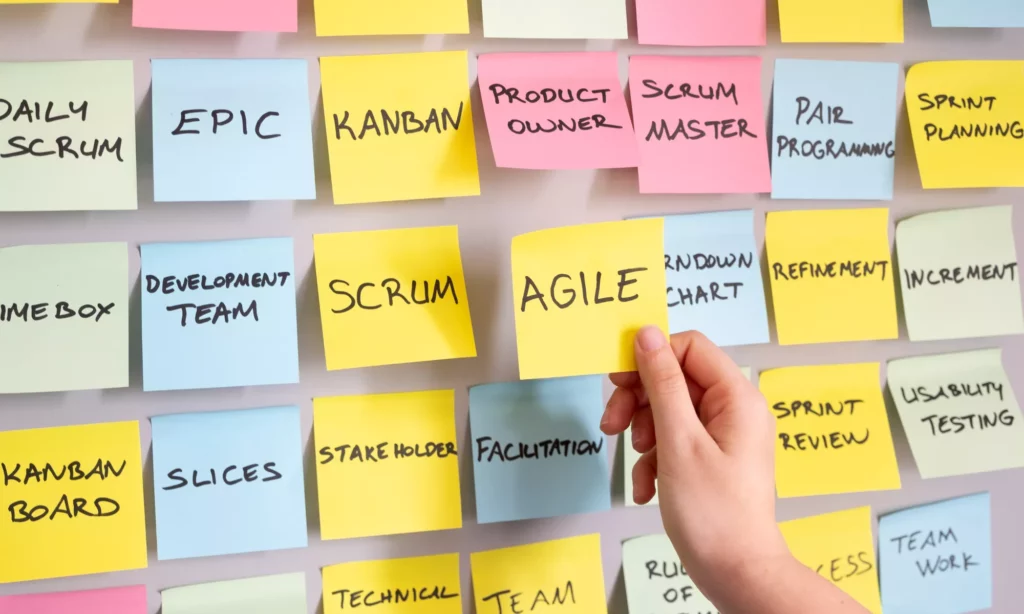
We’ve walked through a step-by-step Agile project sample. Now, let’s learn about how Agile methodologies are truly adopted in real life, not only in software development but also in marketing campaigns and product launches.
Software Development Example
When it comes to Agile, people immediately think of software development without second thoughts. In a typical Agile software project, a team doesn’t build everything at once. Instead, they deliver small, usable pieces of a feature over time.
For example, at Designveloper, our teams build products like Lumin PDF, ODC, or Swell & Switchboard using Agile practices such as Scrum, Pair Programming, Behavior-Driven Development (BDD), and Test-Driven Development (TDD). The Agile software development lifecycle usually flows through requirements gathering (often led by Business Analysts), UI/UX design, coding, testing, and then iterative delivery based on user feedback. A typical iteration often takes around 2-4 weeks.
From our team’s experience, below are several practices if you want to use Agile effectively in software development:
- Break features into bite-sized user stories that your team can complete within a single sprint.
- Prioritize feedback early, even if the software isn’t “perfect” yet.
- Don’t treat testing as a final step. Instead, it should happen alongside development.
- Maintaining close collaboration between developers, designers, and stakeholders. When communication flows, your software tends to improve naturally.
Marketing Campaign Example
Today, Agile isn’t just for developers, but spans to other departments, typically marketing. Instead of launching one big campaign and hoping for the best, marketing teams can run smaller experiments: A/B testing ad creatives, adjusting messaging weekly, and iterating based on real performance data.
A successful example of using Agile marketing is MetLife. As a global insurer, MetLife applied Agile marketing to boost pet insurance sales.
They built a cross-functional team that included traditional marketing, content strategy, data analytics, and even IT. Then, they took time to educate everyone on what Agile meant, why they were using it, and how it worked in practice. Further, they organized on-site training to align teams before running iterative campaigns.
If you want to use Agile marketing effectively, take the following best practices:
- Create fast feedback loops, like weekly reviews.
- Keep plans flexible because what works this week might not work next week.
- Ensure everyone involved understands the process.
Product Launch Example
Agile is also adopted for launching products. Many companies like Toyota or Tesla formed Agile teams to release smaller versions, gather feedback, and improve products constantly instead of waiting months or years to launch everything at once. This usually requires close collaboration between development, marketing, and product teams to keep the process smooth.
Take Toyota as an example. Toyota has combined its known Lean principles (Toyota Production System) with Agile practices to develop and launch software-driven automotive features and connected services. Their teams work in shorter cycles, test components earlier, and refine based on real-world data.
To successfully use Agile for product launch, consider the following practices:
- Ensure everyone involved agrees on priorities, even when things evolve.
- Enable continuous delivery to reduce risk and speed up improvements.
Famous Agile Project Management Success Stories

To better understand how companies have successfully adopted Agile approaches, take a look at those real-life success stories:
- BBVA
BBVA used Scrum and scaled Agile practices to modernize its digital banking services. Their testing on Agile approaches started in 2014, with the goal of building a new mobile banking app. This shift to Agile helps them respond faster to customer needs and deliver an app that wins Forrester’s Best App for three consecutive years.
This success laid a foundation to form a large number of Scrum teams (also called “digital factories) to conduct high-impact business projects. Further, the company changes its siloed organizational structure into something more flexible by adopting Agile. They also released the SDA (Single Development Agenda) to identify, prioritize, and allocate resources to the most impactful projects, aiming for Agile alignment.
- Bosch
Bosch adopted various approaches, from dual organization to Agile-traditional hybrid, but they witnessed no positive signs. So, they decided to apply the fully Scaled Scrum for the entire organization, including the leadership.
The goal was to better coordinate large, distributed teams working on complex engineering products. After adopting Scrum at scale, Bosch reported improved productivity, faster delivery cycles, and more alignment between teams that previously worked in silos.
- Cisco
Cisco started moving from the Waterfall methodology to Scaled Agile for two important projects. They include Cisco® Subscription Billing Platform and WebEx® App for Samsung. Accordingly, Cisco carefully chose the right members for Agile Scrum teams, picked test automation tools, and adjusted when needed. This shift helped Cisco reduce defects by 40% and increase quality assurance by 25% even when its teams worked in distributed environments.
Common Pitfalls in Agile Projects

As the success stories show, Agile has delivered impressive results to many companies worldwide. But is Agile always the best choice? The answer is no.
Even Bosch initially failed when adopting Agile. It’s not because they didn’t choose the full-scale Scrum from the first time, but because they took the wrong steps and strategies. Many companies fall into the same situations as Bosch, and below are some common pitfalls:
- Treating Agile like a rigid process: Many teams follow Agile too strictly by turning it into a checklist rather than a mindset. However, Agile is designed to be flexible, not bureaucratic. So, you don’t need to follow every step or practice of certain Agile frameworks. Consider eliminating unnecessary practices based on project requirements.
- Unclear product vision: Agile is widely adopted for projects with evolving or initially unclear requirements. But it doesn’t mean it can guide the whole team to the right direction without a clear product vision.
- Poor backlog management: Not all tasks are must-haves. Some are nice to be implemented later. So, failing to prioritize tasks and manage the backlog can result in project failure.
- Wrong member choice & weak communication: Ineffective Agile teams often lack all the skills needed to implement specific projects. Further, members within those teams often fail to communicate well, maybe because of time zone differences, cultural differences, or working styles.
- Overloading sprints: Trying to do too much in a short iteration is a typical mistake. It leads to burnout, unfinished work, and Agile fatigue across the team.
- Insufficient Agile training: Adopting Agile means teams have to follow a new workflow. But not every member understands what Agile means and what they should do to collaborate well with others. So, training is always a must before jumping into Agile.
Tips to Apply Agile Successfully

After looking at those common pitfalls, you may realize that Agile doesn’t fail on its own. The failure often originates from how Agile teams are formed, how Agile is implemented, and which tools are used. So, if you want Agile teams to work well, don’t just look at the Agile methodology sample. Instead, consider the following tips as well:
- Start with a clear, shared vision: Before jumping into real work, ensure everyone understands what they’re building, why, and what they need to do.
- Invest in Agile mindset and training: Don’t follow Agile frameworks strictly. Instead, organize work around the core Agile philosophy: respond to changes flexibly and remove unnecessary steps. Further, hold training sessions to help your team understand the importance of the shift to Agile.
- Be realistic with sprint planning: Don’t cram an Agile sprint with many tasks. Instead, assign tasks based on team capacity and the project’s prioritization using estimation techniques.
- Keep user stories small and meaningful: Break work into manageable pieces that team members can implement within a single sprint.
- Prioritize continuous feedback: Don’t wait until the end to validate ideas. Regular input from users and stakeholders helps you adjust early.
- Focus on collaboration, not just roles: Agile teams work best when people communicate openly and support each other.
- Use the right tools: Choose the right tools and approach that your team is familiar with or excel at for development, testing, and project management.
Take retrospectives seriously: Don’t hold retrospectives just because it’s an unavoidable part of Agile. Instead, take it as a chance to review your work and learn from others to improve the work and product in upcoming sprints.
Also published on

Share post on










Read more topics











You may also like



Agile Methodology Sample: Real Examples & Success Stories
Agile Methodology Sample: Real Examples & Success Stories Published March 20, 2026
What Is An Agile Team? Structure, Roles & Responsibilities
What Is An Agile Team? Structure, Roles & Responsibilities Published March 19, 2026
What Is Agile Project Management? Benefits & Best Practices
What Is Agile Project Management? Benefits & Best Practices Published March 18, 2026