









AI Agent Vs Chatbot: Key Differences, Use Cases, And Best Fit

KEY TAKEWAYS:
- Chatbots handle defined conversations: They answer questions and guide users through predictable paths.
- AI agents handle multi-step work: They can plan, use tools, and adapt actions within clear boundaries.
- Choose the lighter option first: A chatbot is often enough for common support or information needs.
- Plan controls before autonomy: Agents need reliable data, monitoring, escalation, and clear ownership.
As AI adoption grows, many teams find themselves stuck on a surprisingly simple question: should they use an AI agent or a chatbot?
At a glance, the two can look similar. But in practice, they serve different purposes and work in different ways. Choosing the wrong one often leads to wasted time, poor user experience, or systems that don’t actually solve the problem they were meant to handle.
This confusion isn’t trivial. According to RAND Corporation, up to 80% of AI projects fail, often because businesses don’t clearly define the problem or choose the right type of solution in the first place.
This article provides a practical breakdown of how AI agents and chatbots differ. It also discovers where each one delivers real value and how to match the right choice to specific business scenarios.
Recommended for you:
- Customer Service Chatbots: 10 Best Platforms And Use Cases
- How To Build An AI Chatbot With Long-Term Memory? (Guide)
- Chatbot Integration With ChatGPT: A 5-Step Guide
What Is A Chatbot?
A chatbot is a software application that simulates human conversation (often through text or voice) to answer questions, guide users, or complete simple tasks.
Further reading:
- Types of AI Agents: Key Categories and When to Use Each
- What Is Agentic AI? Benefits, Architecture and How It Works
- A Practical Guide To AI Agent Architecture With Diagrams

Chatbots are natively built to respond, not act independently like AI agents. Some are basic and follow predefined rules, while others use advanced language models and learned patterns (from user interactions) to create more natural responses in a conversation. That said, they still share the same goal: help users get information quickly without needing a human agent.
How Chatbots Work
Users interact with a chatbot easily through a chat interface. When they send a message, the chatbot processes it through one of two mechanisms:
- Traditional chatbots use decision trees and keyword matching: a specific input triggers a predefined response path.
- More advanced chatbots use natural language processing (NLP) to interpret intent. So phrasing variations like ‘track my package’ and ‘where is my delivery’ can trigger the same response flow.
The workflow follows a consistent pattern:

Behind the scenes, things are more complex. Traditional chatbots rely on decision trees and predefined rules: if a user clicks a button or types a specific keyword, the bot follows a scripted path. Besides, more advanced chatbots use natural language processing (NLP) to interpret intent, even when phrasing varies. For example, “track my package” and “where is my delivery” can trigger the same response flow.
Modern AI-powered chatbots go a step further by using large language models to generate replies dynamically. Instead of pulling from fixed scripts, they analyze context and deliver human-like responses.
Still, most chatbots operate within boundaries. Accordingly, they’re connected to a limited set of data sources or actions to focus on answering rather than executing complex tasks.
What Chatbots Do Best
Chatbots deliver the most value when speed, consistency, and availability matter more than deep reasoning or autonomous action:
- High-volume repetitive queries: Chatbots handle FAQs, order tracking, appointment scheduling, and basic troubleshooting at scale. Accordingly, they can deliver consistent answers 24/7 without human intervention.
- Brand-consistent communication: Because chatbots operate within defined rules or data sources, responses stay aligned with tone guidelines and are easier to audit and control.
- Structured guided flows: Chatbots excel at walking users through predictable step-by-step processes. That’s why they fit tasks like filling out a form, booking a service, or collecting information through a series of prompts.
The strength of chatbots is also their limit. Once a situation requires multi-step reasoning, action across external systems, or adaptive decision-making, rule-based and even LLM-powered chatbots reach their boundaries. That is where AI agents become relevant.
What Is An AI Agent?
An AI agent is a software system that can perceive information, make decisions, and take actions autonomously to achieve a specific goal.
Related reading:
- Agentic AI Architecture: Components, Workflow, Design Patterns
- AI Agent Orchestration: How Multi-Agent Workflows Work In Practice
- Enterprise AI Agents: Use Cases, Tools, And Implementation Guide
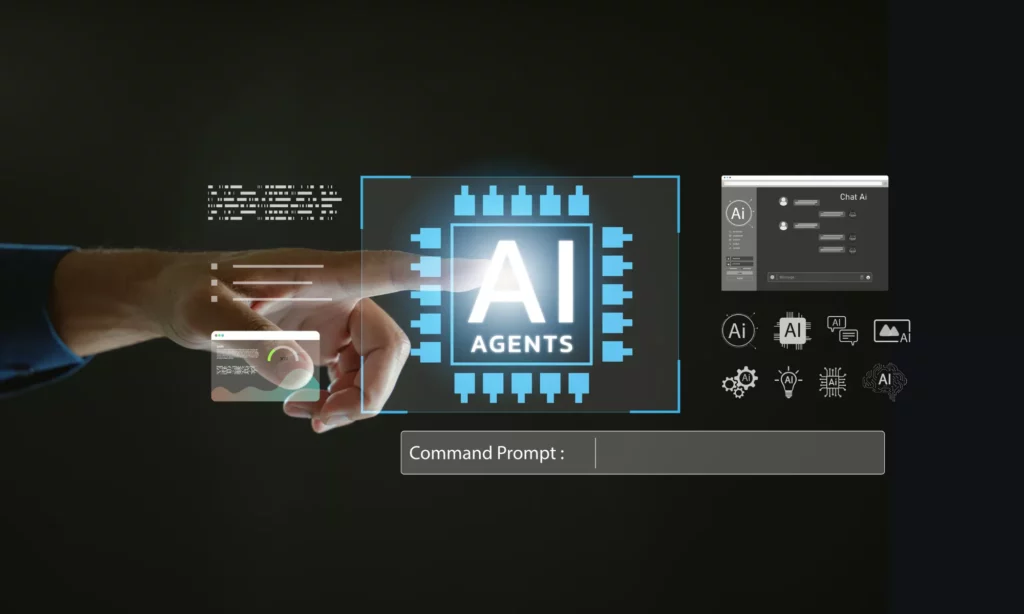
The clearest way to distinguish an AI agent from a chatbot: a chatbot is a conversation tool, while an AI agent is a digital worker. More particularly, a chatbot waits for input and responds within a defined scope. But an AI agent breaks a goal into steps, plans tasks, executes them across systems, and adjusts along the way based on results. It even integrates with external tools to complete multi-step work with minimal human intervention.
In a customer support scenario, for example, a chatbot answers ‘How do I book a flight?’ Meanwhile, an AI agent searches available options, compares prices, selects the best match based on defined criteria, and completes the booking without additional prompting.
As more customers expect personalized experiences and businesses look to automate repetitive work, AI agents are gaining serious traction. According to Grand View Research, the global AI agent market is expected to reach $10.91 billion in 2026 and grow at a remarkable 49.6% annually through 2033. This rapid growth reflects a radical shift from AI that simply responds to AI that actually gets things done.
How AI Agents Work: A 4-Layer Architecture
AI agents combine four interconnected components that enable autonomous, multi-step execution:
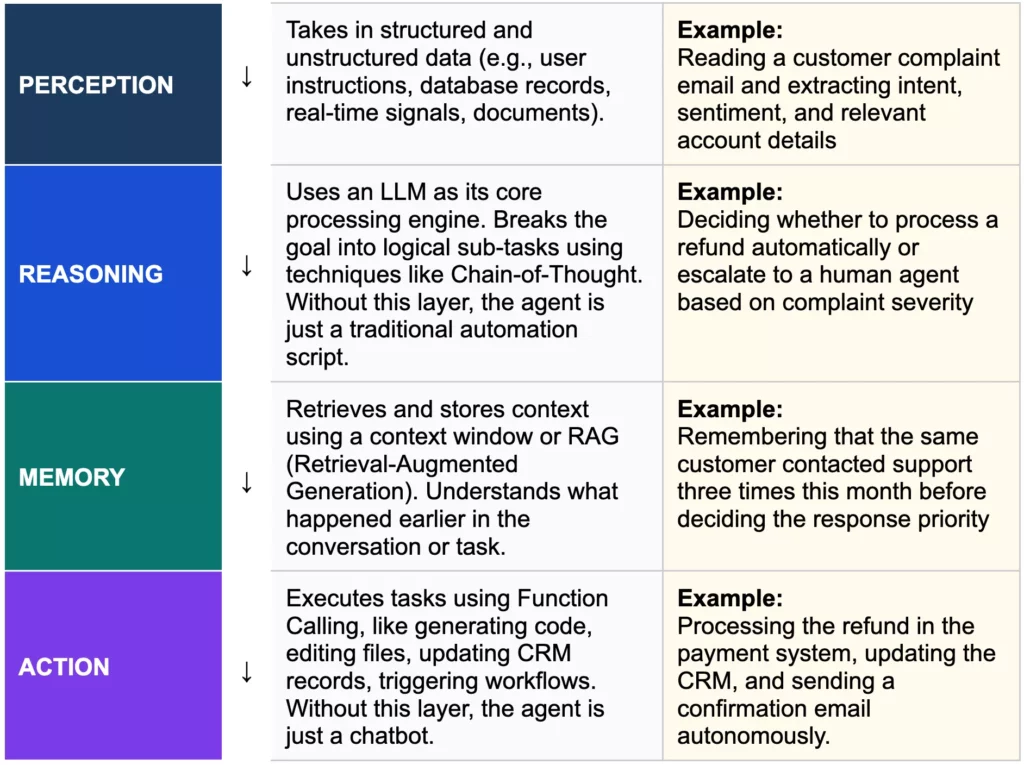
By repeating the cycle of perceiving, reasoning, remembering, and acting, AI agents handle complex workflows rather than delivering single responses. This loop is what separates them from both traditional automation scripts and conversational chatbots.
What Makes AI Agents More Advanced
AI agents become more advanced than traditional chatbots because of the following factors:
- Autonomy and scope: Chatbots respond within a defined conversation. But AI agents use information, tools, and reasoning to take autonomous actions across systems without step-by-step human instruction.
- Multi-step reasoning: AI agents break down complex tasks into smaller actions, implement them in sequence, and adapt if something changes mid-task. For example, if a data source fails or results look inconsistent, the agent can retry, choose an alternative, or flag the issue.
- Tool integration: AI agents connect with external systems (CRMs, databases, APIs, internal software) to perform high-precision tasks. Besides, more advanced agents can also interact with computer interfaces directly (known as ‘Computer Use’) to operate software without official APIs.
- Context awareness and memory: AI agents can retain information across steps, understand broader objectives, and personalize outputs based on historical data. This makes agents proactive rather than reactive.
AI Agents Vs Chatbots: Key Differences
The simplest way to set them apart: chatbots respond, while AI agents act. To better understand how, let’s take a look at the comparison table below:
| Key Aspects | Chatbots | AI Agents |
|---|---|---|
| Core Function | Conversational response system | Autonomous task execution system |
| Autonomy | Reactive (wait for user instructions) | Proactive (plan and execute tasks autonomously) |
| Decision-making | Follows predefined decision trees and rules | Makes context-based decisions independently |
| Task complexity | Handles simple, repetitive queries (FAQs, order status) | Manages complex, multi-step workflows end-to-end |
| Learning & adaptation | Static; requires manual updates to improve | Continuously learns from interactions over time |
| Memory | Limited or no memory between sessions | Maintains context across conversations and interactions |
| System integration | Limited; typically operates within a single interface | Integrates with CRMs, APIs, databases, and external tools |
| Personalization | Low; responses are largely uniform | High; adapts to individual user preferences and history |
| Deployment complexity | Lower; fewer integrations and backend logic required | Higher; requires tool integrations, governance, and oversight |
| Best when | The problem is predictable and the answer is clear | The task requires reasoning, action, and system integration |
Chatbot vs. AI Agent: When to Use
Understanding the differences between chatbots and AI agents is only the starting point. The real question is which technology fits a specific business problem, team readiness, and workflow structure. The decision framework below explains common scenarios to the right choice, with reasons and real-world examples.
| Scenario | Recommended | Why | Real-world Example |
|---|---|---|---|
| High-volume repetitive queries: FAQs, order tracking, business hours, return policies | Chatbot | Predictable inputs and outputs. Rule-based logic is sufficient; no multi-system execution needed. | Retail brand handling 50,000+ daily ‘Where is my order?’ inquiries |
| Guided structured workflows: appointment booking, form filling, lead qualification | Chatbot | Fixed decision paths work well. Chatbot logic is easier to build, audit, and control. | Insurance company collecting claim details step-by-step via chat |
| Multi-step tasks requiring action across systems: book + confirm + update CRM + notify | AI Agent | Requires reasoning across steps and tool integration (CRM, calendar, email, databases). | Travel platform that searches, books, and sends confirmation autonomously |
| Dynamic or unpredictable inputs that vary widely in nature and context | AI Agent | Rule-based chatbots break on edge cases. Agents reason from context and adapt their approach. | Healthcare intake agent triaging varied patient symptoms and routing to the right specialist |
| Complex analysis + autonomous action: fraud detection, financial reporting, research | AI Agent | Requires data synthesis from multiple sources, pattern recognition, and real-time decision-making. | Fintech platform scanning transactions and auto-blocking suspicious activity |
| High-volume front-line queries + complex back-end resolution in the same flow | Hybrid | Chatbot manages the conversation layer. AI agent handles system execution behind the scenes. | E-commerce: chatbot answers FAQs, agent processes refunds and updates records autonomously |
| Gradual automation: starting simple and scaling over time as workflows mature | Hybrid | Start with a chatbot for quick deployment and ROI. Layer in agent capabilities as needs grow. | SaaS company beginning with an FAQ bot, adding workflow automation over 6–12 months |
Additional Factors That Influence the Decision
Beyond the scenario itself, three operational factors shape the final choice:
- Deployment timeline: Chatbots can go live in days to weeks. Meanwhile, AI agents with full tool integration and governance structures typically require weeks to months of planning and testing.
- Governance readiness: AI agents make autonomous decisions and take real actions, which means errors have real consequences. So, teams need clear review processes, escalation paths, and audit trails before deploying agents in production.
- Cost structure: Chatbots carry lower upfront development and maintenance costs. Meanwhile, AI agents require more investment in integration, prompt engineering, and ongoing monitoring. But they typically deliver higher ROI for complex, high-volume workflows.
Will AI Agents Replace Chatbots?
Not entirely, but AI agents are rapidly taking over the use cases where traditional chatbots once performed best.
In industries like SaaS, eCommerce, and logistics, AI agents are already handling not just complex workflows but also tier-1 queries that previously required chatbot triage. According to McKinsey, deploying AI agents can cut time and costs by 40-50% while improving annual productivity by 3-5%.
That said, the transition is not absolute. Chatbots remain the better choice when tighter control over conversation flows, predictable responses, and faster deployment matter more than execution capability. Besides, modern systems tend to combine both: a chatbot for the conversation layer and an AI agent for complex back-end resolution.
The more important shift is not chatbot vs. agent. But it is moving from choosing tools to designing the right workflow architecture for the problem at hand.
Real-World Use Cases: Chatbot vs. AI Agent in Practice
Both chatbots and AI agents are proven across industries. But they solve different problems. The examples below illustrate how each technology operates in different contexts:
Explore more:
- What Is AI Automation? How It Works, Benefits, Tools, and Use Cases
- How To Build And Use AI Business Process Automation Effectively
- AI Agent Governance: How To Manage Agents In Production
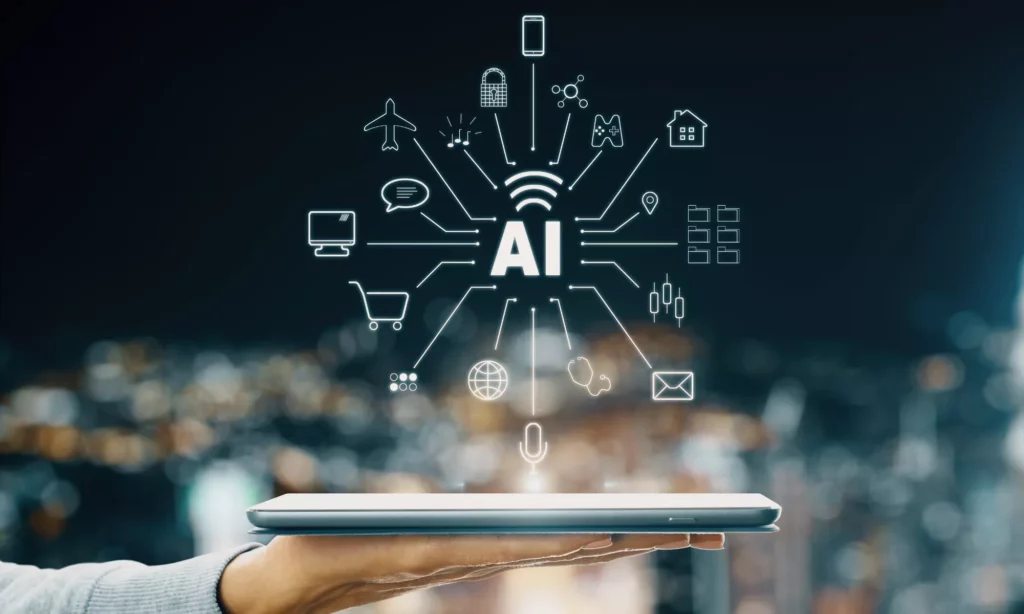
Customer Support
- Chatbot: An e-commerce brand deploys a rule-based chatbot to handle 80% of incoming queries (e.g., order status, return policies, and account FAQs). This reduces support ticket volume without human involvement.
- AI Agent: Agents can process incoming support tickets, extract customer data, and resolve common issues autonomously. Salesforce indicates that its Agentforce retrieves the right data, builds action plans, executes tasks, and adapts to real-time changes using the Atlas Reasoning Engine.
Healthcare
- Chatbot: A hospital deploys a chatbot on its website to guide patients through appointment booking and pre-visit instructions. The chatbot accordingly works in structured, predictable flows with no clinical reasoning required.
- AI Agent: AI agents in healthcare assist clinical documentation (e.g., Nuance), handle patient triage (e.g., Infermedica), and support insurance and administrative tasks (e.g., Innovaccer). For example, Hippocratic AI uses data from wearables to monitor vitals, then autonomously encourages patients to take medication or notify human nurses when data shows dangerous trends.
Internal Workflow & Productivity
- Chatbot: An HR chatbot automates high-volume, repetitive queries to support HR management, IT self-services, knowledge management, and administrative tasks.
- AI Agent: AI agents support different internal workflows to improve productivity. For example, HRM, a Mattermost-based internal assistant built by Designveloper, supports HR workflow automation and employee self-service by handling booking, leave requests, approvals, and policy lookups.
Software Development
- Chatbot: A developer-facing chatbot answers documentation questions, explains error messages, and retrieves code examples. It is useful for reference without taking autonomous action.
- AI Agent: Many AI coding assistants like GitHub Copilot and Devin have agentic capabilities to implement changes across multiple files, suggest next edits, and conduct inline security scanning.
AI Agents Vs. RPA: What’s The Difference?
For teams already using Robotic Process Automation, understanding how AI agents differ from – and complement – RPA is important. The clearest difference between them: AI agents think, while RPA executes.
RPA (Robotic Process Automation) uses software robots to perform repetitive, rule-based tasks: logging into systems, copying data, running fixed workflows. It is built for structured, unchanged processes. Meanwhile, AI agents use LLMs and external tools to handle complex, dynamic tasks independently. They reasoning through ambiguous problems rather than following fixed scripts.
| Key Aspects | AI Agents | RPA |
|---|---|---|
| Core behavior | Autonomous reasoning and decision-making | Rule-based, deterministic task execution |
| Data handling | Excels with unstructured data (emails, documents, conversations) | Requires structured, predictable data inputs |
| Adaptability | Learns and adapts to new scenarios over time | Breaks when workflows, UI, or rules change |
| Decision-making | Makes context-aware, multi-step decisions | Follows fixed decision trees with no judgment |
| Task complexity | Handles dynamic, exception-heavy, end-to-end workflows | Best for repetitive, high-volume, stable processes |
| Learning | Improves through reinforcement learning and memory | No learning capability; static until manually updated |
| Technology stack | LLMs, memory modules, planners, vector databases | UI automation, workflow engines, scripting languages |
| Supervision needed | Semi-autonomous; humans involved in high-risk decisions | Minimal oversight when processes are stable |
| Transparency | Less predictable; outputs can vary by context | Fully auditable; actions follow predefined logic |
In practice, many organizations adopt a hybrid system that combines AI agents (for reasoning and managing complex tasks) and RPA (for handling high-volume, repetitive work).
Example: A customer complaint arrives as an unstructured email. An AI agent reads an unstructured email to understand the nature and sentiment of the complaint (Reasoning). Then, it triggers an RPA bot to extract the customer’s account data (Execution) and evaluates the data to decide the suitable solution. After that, the agent triggers a second RPA bot to update the CRM record and send a confirmation email (Outcome).
FAQs About AI Agent Vs Chatbot
What Is The Core Difference Between An AI Agent And A Chatbot?
The core difference between AI agents and chatbots is capability and intent. Accordingly, chatbots are designed to respond to user inputs, usually within a defined scope like answering questions or guiding simple workflows. Meanwhile, AI agents are built to plan steps, make decisions, and execute tasks across systems. Instead of just telling you how to do something, it can often do it for you.
Which Is Better For Business Operations: Chatbot Or AI Agent?
It depends on the problem being solved. Chatbots deliver the most value for high-volume communication, FAQ handling, and structured workflows where consistency and speed matter more than execution. But AI agents are the better choice for automating complex, multi-step workflows that require system integration, real-time decision-making, and autonomous action. In most mature implementations, the two work together rather than replacing each other.
How long does it take to deploy a chatbot vs. an AI agent?
Chatbots can typically go live in days to a few weeks. This depends on the complexity of the decision trees and the number of integrations required. Meanwhile, AI agents with full tool integration, governance structures, and multi-step workflow logic generally require several weeks to months. One common approach is starting with a chatbot for quick wins and layering in agent capabilities over time.
What is the cost difference between a chatbot and an AI agent?
Chatbots have lower upfront development and ongoing maintenance costs. But AI agents require more investment in prompt engineering, tool integrations, monitoring infrastructure, and human oversight processes. However, for complex workflows where the cost of manual handling is high, AI agents typically deliver stronger long-term ROI.
What Are The Primary Capabilities Of An AI Agent?
The primary capabilities of AI agents include multi-step task execution, decision-making, tool integration, context awareness, and adaptation based on outputs or changes. These strengths allow them to handle workflows like data analysis or process automation with minimal human input.
What Are The Primary Capabilities Of A Chatbot?
The primary capabilities of chatbots include the ability to handle high volumes of common, low-complexity tasks consistently. They can guide users through structured processes (e.g., booking or troubleshooting) and provide instant responses.
Is ChatGPT A Chatbot Or An AI Agent?
At its core, ChatGPT is a conversational chatbot that gets a prompt and generates a response. Although many posts said that it now evolves beyond a simple chatbot, it doesn’t mean it becomes an AI agent. However, due to function calling, web browsing, and other extended capabilities, ChatGPT can now exhibit agentic behavior. This makes it closer to an assistive agent rather than a fully AI agent that can autonomously perform actions.
Can A Chatbot Become An AI Agent?
Yes, but not by default. A chatbot can evolve into an AI agent when its capabilities are extended beyond conversation. This often involves adding access to external tools or systems, logic for decision-making and task planning, and the ability to execute actions (not just respond).
For example, a chatbot that only answers support questions can become an AI agent if it can also process refunds, update records, or trigger workflows automatically. In other words, the shift happens when the system moves from responding to doing.
Conclusion
Chatbots and AI agents are complementary tools that solve different problems at different levels of complexity. Particularly, chatbots handle conversation consistently and at scale. Meanwhile, AI agents take action, execute workflows, and adapt to dynamic situations that rule-based systems cannot handle.
In most production environments, the question is not which to choose, but how to combine them into an architecture that fits the actual workflow. The decision ultimately comes down to three questions: How predictable is the input? Does the system need to take action or just respond? And how mature is the team’s readiness to govern autonomous AI outputs?
| How Designveloper Can Help Many businesses understand the differences between AI agents vs chatbots. But they still struggle to turn that understanding into systems that actually fit your product, processes, and teams. Are you also in that case, either adding AI that slows down development or enforcing unsuitable automation? If yes, you may want a reliable AI development partner. Designveloper is an AI-first software and automation company in Vietnam. Unlike agencies that stop at prototypes or generic chatbot demos, we build custom AI systems, intelligent workflows, and digital products that work seamlessly with actual processes to reduce manual work and costs. Typically, our teams have helped Aha integrate AI to automate operations by generating content (e.g., titles and descriptions), cleaning image backgrounds, and summarizing customer-support conversations. We also develop Song Nhi, an AI financial assistant that supports OCR-based transaction extraction from receipts and statements, auto-tagging, and account description generation. Whether you want AI integrations, intelligent products, or legacy modernization, talk to our team! Designveloper helps you develop an effective product that truly addresses your pain points. |
Map the workflow, decision risk, and required integrations first. That makes it easier to decide whether a chatbot, an AI agent, or a combined approach is the right next step.
Also published on

Share post on








Related Articles


Is Vibe Coding Legal? Ownership, Copyright, and Release Risks
Is Vibe Coding Legal? Ownership, Copyright, and Release Risks Published October 16, 2026
How to Build a Chatbot with LangChain in Python: 6 Steps
How to Build a Chatbot with LangChain in Python: 6 Steps Published October 16, 2026
Agentic AI Replacing AI: How Workflows Change and When to Switch
Agentic AI Replacing AI: How Workflows Change and When to Switch Published October 16, 2026