














Why More Companies Are Moving to Docker VPS Hosting Amid Growing Traffic Demands
December 30, 2024


In the digital age, there is a high demand for companies to have an online presence as website traffic continues to grow. Amid ever-increasing traffic demands, many companies are moving towards Virtual Private Server (VPS) hosting, especially with the help of Docker, a highly scalable container platform.
Here are some of the reasons why website traffic is vital for companies of all shapes and sizes that want to succeed in 2025 and beyond:
Traffic boosts visibility: The more traffic your website receives, the more exposure your company and its products or services get. Eventually, websites with more traffic rank higher on search engine results pages (SERPs), increasing your visibility even more.
Traffic boosts brand awareness: When people visit your website multiple times, they become more familiar with your brand name, logo, and products or services. Brand awareness fosters trust and increases customer loyalty.
Traffic generates leads: By capturing visitor information (for example, asking for a visitor’s email to receive a newsletter or e-book), you generate more leads that can be nurtured through email marketing or other outreach strategies. If done well, lead nurturing can increase sales.
Traffic increases sales opportunities: Your website becomes a 24/7 salesperson, allowing consumers to browse your products or services and make purchases at a time and from a place that is convenient for them. In fact, 59% of consumers prefer making their purchases online.
Traffic provides data and insights: Website traffic provides companies with valuable data and insights that help them better understand their audiences, improve search engine optimization (SEO) and digital marketing efforts, and make data-driven business decisions.
Now that you recognize why website traffic is so crucial for success, it’s essential for companies to understand how they can ensure their websites are able to handle the growing traffic demands of the online world.
This article will explore everything you need to know about Docker VPS hosting and why more companies are opting for this hosting solution in 2025.
What is Docker?
Docker is an accelerated container application platform, designed to help developers build, share, and run container applications.
Instead of deploying applications in traditional virtual machines (VMs), Docker hosting uses containerization to create lightweight, portable, and highly scalable hosting environments. A container is an isolated application that runs without being affected by the bugs, crashes, and security vulnerabilities that affect other applications running on the same system.
Using a provider like Hostinger’s Docker hosting, users can also enjoy an optimized setup that makes deploying, scaling, and managing containers even simpler, thanks to Hostinger’s seamless integration with other popular developer tools.
Docker can be run on a system of any size, from those with just a few applications to large cloud instances for large companies. In addition, Docker containers can be easily transferred between systems, making development and testing easier.
What Is VPS Hosting?
VPS hosting is powered by a single physical server that is split into multiple virtual servers, meaning you get dedicated resources, including the Central Processing Unit (CPU), Random Access Memory (RAM), and your own storage space.
In addition, resources are distributed virtually, so it’s straightforward for users to add more CPU, RAM, and storage, enabling them to scale faster than with shared servers.
VPS hosting provides companies with the control and flexibility of a dedicated server whilst being cheaper because server costs are shared.
The combination of Docker and a VPS is especially robust because a VPS makes it easy to scale up a server quickly, whilst Docker ensures your website won’t be affected by others running on the same system. This integration results in a hosting environment that’s highly scalable, consistent, and cost-effective.
If you want the flexibility of a VPS but don’t have the time, effort, or technical skills to update and manage it, you can use a managed hosting provider. With a managed VPS, the hosting provider handles security, updates, and basic maintenance, so you don’t have to.
Other types of hosting solutions include:
Shared hosting: With shared hosting, multiple websites share the same physical server and its resources (for example, storage, CPU cores, RAM, and bandwidth). Shared hosting is the cheapest solution and is often easy to set up. However, you have limited control over performance and customization, which only makes it suitable for small personal sites, blogs, or businesses with low to medium traffic.
Cloud hosting: Instead of a single physical server, resources are provided by a network of servers. Cloud hosting is highly scalable as you can adjust CPU, RAM, and storage on demand. However, it can be costly and often requires advanced technical skills.
Dedicated hosting: Dedicated hosting lets you rent an entire physical server, maximizing performance, improving security, and giving you complete control. However, like cloud hosting, this is an expensive solution that requires strong technical skills.
Why More Companies Are Moving to Docker VPS Hosting?
Amid growing traffic demands, companies of all sizes, from startups to large-scale enterprises, have increasingly moved towards Docker VPS hosting. This is mainly because Docker Compose or lightweight orchestrators make scaling straightforward.
Docker is a container that can be easily moved between systems and scaled up when required. This means that applications that suddenly receive unexpectedly high traffic can be scaled up instantly with just a few clicks.
However, when using Docker to quickly scale a container to handle heavy traffic, it’s crucial to ensure your VPS provider makes it easy to scale your VPS as well.
Whilst scalability is the most important advantage amid growing traffic demands, here are some other reasons why companies are moving towards Docker VPS hosting:
Consistent hosting environment: Docker allows developers to package applications and all their dependencies into containers. When these containers run on a VPS, companies get identical environments across development, staging, and production.
Improved resource efficiency: VPS hosting gives you dedicated CPU, RAM, and storage, whilst Docker containers let you use the VPS resources far more efficiently than full VMs. Essentially, companies get the elasticity of cloud hosting without paying cloud-provider prices.
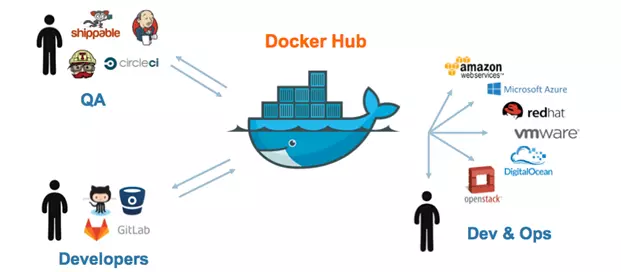
Faster deployment: Docker integrates seamlessly with other essential DevOps tools, such as GitLab, GitPod, DataDog, OpenTofu, Salt, Google Cloud Platform, and Kubernetes. This dramatically speeds up the process of releasing code changes, features, or updates.
Better security: Compared to running apps directly on a VPS, Docker provides isolated containers for different apps, reduces the attack surface, and has the ability to update individual containers easily.
Lower costs: Docker VPS hosting is often cheaper than dedicated and cloud hosting solutions, whilst still getting more control than shared hosting and more power and stability than basic VPS hosting.
Flexibility to host anywhere: Docker containers are portable so that companies can move from one VPS provider to another without friction. This allows businesses to choose hosting based on cost, performance, or geographic location, whilst preventing vendor lock-in, migration stress, and compatibility issues.
Wrapping Up On Docker VPS Hosting
Whilst Docker VPS hosting has a plethora of benefits that will help companies succeed in a crowded online marketplace, the main advantage is easy and efficient scalability. This comes as websites experience growing traffic demands, driven by over 73% of the world being online and social media sending large amounts of mobile traffic to websites.
Companies can integrate Docker containers with any hosting solution that supports Linux (or Windows containers), as it is designed to be portable. This includes most dedicated and cloud hosting servers, but not shared servers. Shared servers are simple, inexpensive, and limited, so they do not allow the level of access required to run Docker containers.
However, Docker runs best on VPSs because your company gets root access and complete control over scalability.
Also published on

Share post on










Related Articles


Read more topics



AI Development
AI Development

Automation Technologies & Solutions
Automation Technologies & Solutions

Back-End Development
Back-End Development

Best Companies
Best Companies

Blockchain Technology and Applications
Blockchain Technology and Applications

Business Analyst Role & Skills
Business Analyst Role & Skills

Chatbot Development
Chatbot Development

Cloud Technology Revolution
Cloud Technology Revolution

CMS Platforms Development
CMS Platforms Development

Cyber Security
Cyber Security