











What Is Generative AI? How It Works, Examples And Business Impact

KEY TAKEAWAYS:
- Generative AI creates new content, including text, code, images, audio, video, summaries, and structured outputs.
- It grows from foundation models, cloud compute, and accessible tools, but business value depends on workflow fit.
- Common enterprise uses include support, documents, knowledge search, software development, and workflow automation.
- Safe adoption needs trusted data, human review, security, evaluation, and clear ownership.
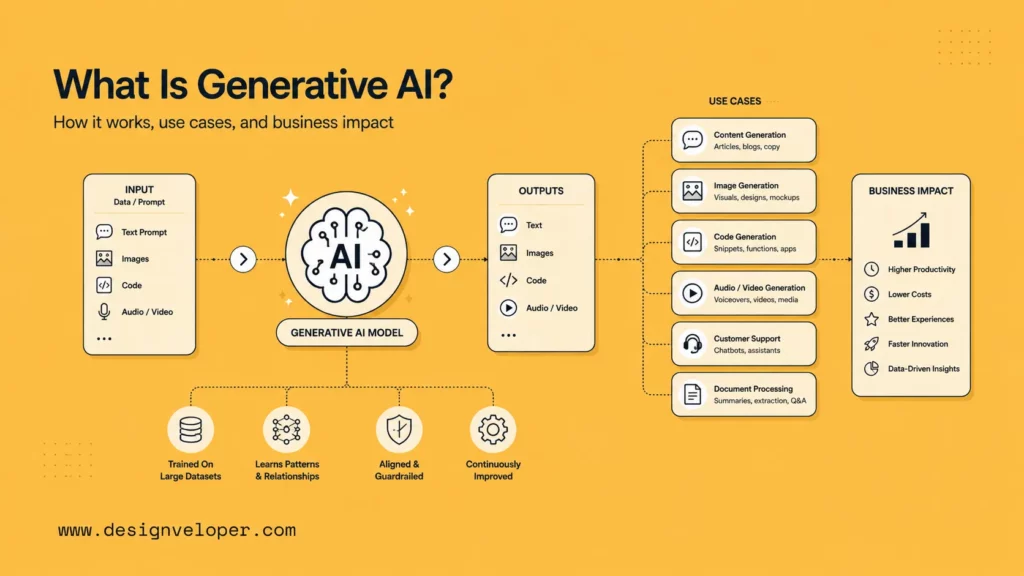
Generative AI is a branch of artificial intelligence that creates new content from patterns it has learned in existing data. Instead of only classifying information, predicting a score, or following fixed rules, generative AI can produce text, images, code, audio, video, summaries, designs, and structured outputs in response to prompts or application instructions.
The simplest way to understand it is this: traditional AI often analyzes what already exists, while generative AI helps create something new. A customer support model can draft a reply. A design tool can create image concepts. A developer assistant can suggest code. A document platform can summarize long contracts and generate a first draft of an agreement.
Current adoption data makes the shift concrete. Stanford HAI’s 2026 AI Index reports that organizational AI adoption reached 88%, and its economy chapter says generative AI reached 53% adoption in three years. Microsoft’s 2025 AI Diffusion Report also estimates that roughly one in six people worldwide now use generative AI tools. These figures show why leaders now ask what is generative AI in direct business terms.
See more:
- What Is AI Integration? How to integrate AI successfully?
- AI Chatbot Development: A Step-By-Step Guide
- Generative AI Applications: 20 Real-World Examples Across Industries
This guide explains what generative AI is in plain business terms: how models are trained and generate outputs, which technologies matter, where companies use them, what risks remain, and how to choose a first workflow with clear review points.
Why Generative AI Is Growing So Fast
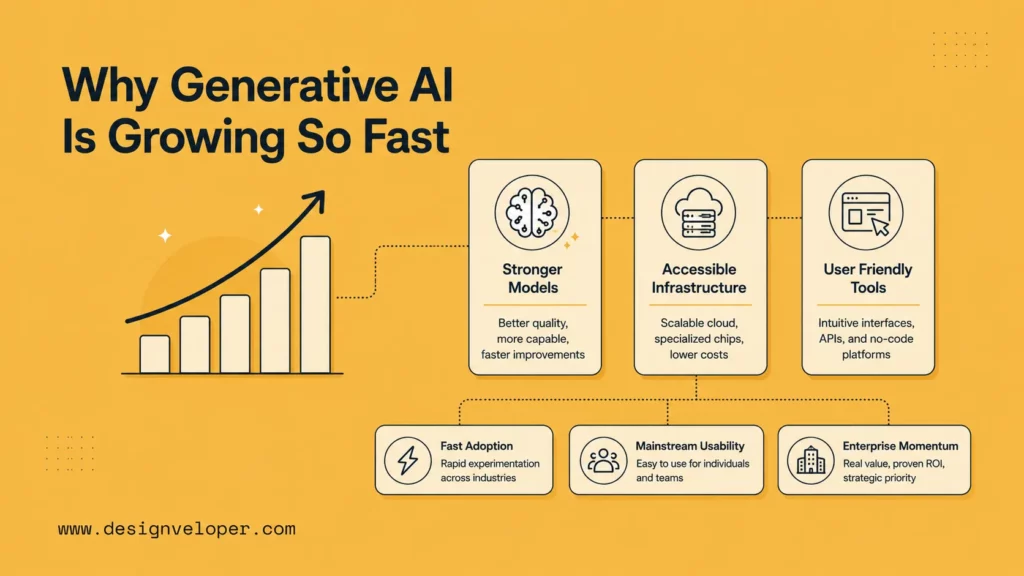
Generative AI has grown quickly because three forces arrived at the same time: stronger model architectures, more accessible computing infrastructure, and user-friendly tools. Earlier AI systems were powerful, but many required specialized teams to operate. Modern generative AI tools changed that by turning complex models into conversational and creative interfaces.
From Early AI Foundations To Modern Breakthroughs
The foundations of generative AI go back decades. Deep learning, neural networks, probabilistic models, and machine learning research all contributed to today’s systems. The major acceleration came from deep learning, GPUs, larger datasets, transformer models, diffusion models, and foundation models that can be adapted to many tasks. IBM notes that modern generative AI builds on a long history of machine learning breakthroughs, while AWS describes foundation models as broad models that can support many general tasks.
How ChatGPT And New AI Tools Accelerated Adoption
ChatGPT made generative AI feel practical to mainstream users. People could type a natural language request and receive a useful draft, explanation, plan, or code sample in seconds. After that, similar interfaces appeared across office software, search, design tools, customer support platforms, developer tools, and analytics products. The result was a shift from “AI as a backend feature” to “AI as a visible collaborator inside the product.”
Where Generative AI Is Heading Next
The next stage is less about isolated content generation and more about AI-powered workflows. Businesses are moving from simple prompt-and-response tools toward retrieval-augmented generation, multimodal systems, agentic AI, and custom assistants connected to internal knowledge, documents, products, and business logic.
How Does Generative AI Work?
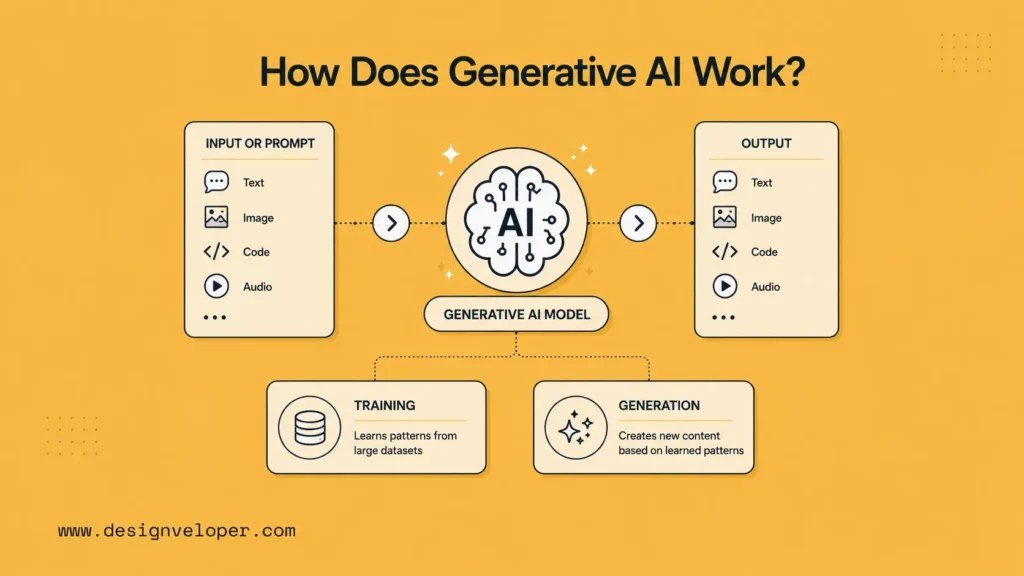
Generative AI works by using neural networks to learn patterns from large datasets and then generate outputs that match a user’s prompt, context, and constraints. NVIDIA explains that generative AI models identify patterns and structures in existing data to create new content. In business applications, this process usually has two broad stages: training and generation.
Training Phase
During training, a model studies examples such as text, images, code, audio, or business records. The model does not store every example as a library of finished answers. Instead, it learns mathematical relationships between elements in the data. In a language model, that may mean learning how words, concepts, syntax, facts, and reasoning patterns tend to relate. In an image model, it may mean learning how visual features, styles, objects, and compositions relate.
Training can also include fine-tuning or instruction tuning. Fine-tuning adapts an AI model to a narrower domain, tone, task, or company workflow. For example, a business may fine-tune or configure a model to understand support tickets, product documentation, medical terminology, legal templates, or software engineering conventions.
Generation Phase
During generation, the user provides a prompt or an application sends structured instructions. The model predicts and assembles an output based on what it learned, the immediate context, and any connected tools or data sources. This is why the same model can draft an email, summarize a policy, answer a question, write code, or propose a design direction depending on the input.
Key Architectures Behind Generative AI
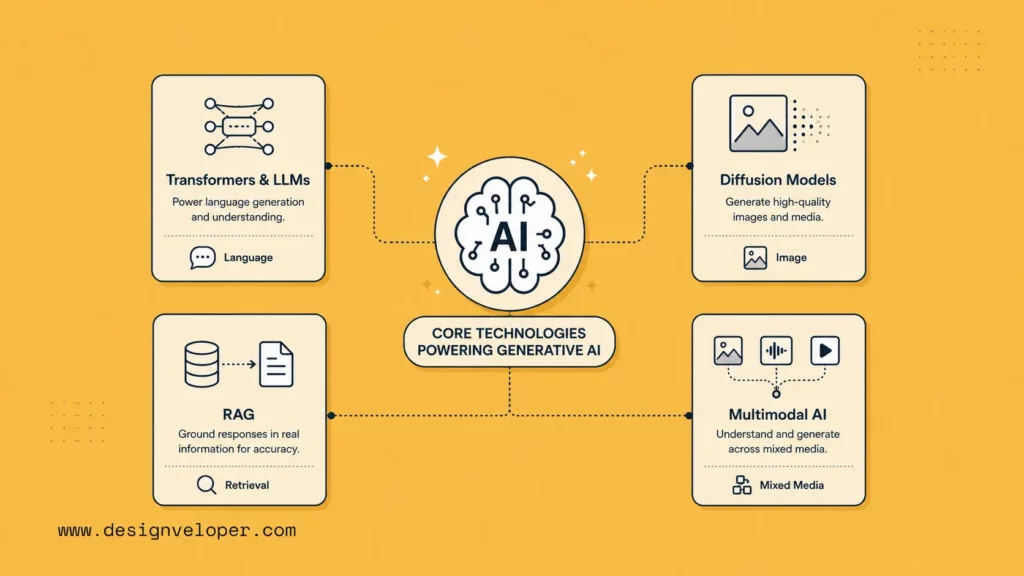
Different generative AI examples rely on different architectures. Transformers power many large language models. Diffusion models power many modern image and video systems. GANs helped shape earlier advances in image generation. Retrieval-augmented generation connects models to external knowledge so answers can be grounded in trusted information instead of relying only on training data.
Core Technologies Powering Generative AI
A strong generative AI system is rarely just one model. It is usually a stack of models, data pipelines, prompts, retrieval systems, guardrails, user interfaces, evaluation methods, and integration layers. Understanding the core technologies helps businesses decide whether to use an off-the-shelf tool or build a custom AI integration that fits their own systems.
Transformers And Large Language Models (LLMs)
Transformers are the architecture behind many well-known LLMs. They are effective because they can process relationships across long sequences of text and context. This is why many large language models are useful for language-heavy workflows. This allows them to write, summarize, translate, classify, reason over instructions, and generate code. LLMs are especially useful when work involves language-heavy tasks such as support, research, documentation, sales enablement, and internal knowledge search.
Diffusion Models For AI Image And Video Creation
Diffusion models are widely used for image generation. They learn to create images by gradually transforming noise into coherent visuals guided by text prompts or other inputs. Similar ideas are also being extended into video, 3D, and design workflows. These systems are useful for concept exploration, marketing visuals, product mockups, and creative production, though businesses still need review processes for brand fit, accuracy, and licensing.
Retrieval-Augmented Generation (RAG)
Retrieval-augmented generation combines a generative model with a retrieval system. Instead of asking a model to answer from memory, the application retrieves relevant documents, records, or database entries and provides them as context. This is especially important for enterprise use cases because it helps ground responses in approved company knowledge. A document chatbot, internal assistant, or policy search tool often performs better when RAG is designed well.
Learn more in:
- How To Build A RAG System: Step-By-Step (New Guide)
- RAG Pipeline Diagram: Components, Workflow, And Production Design
- RAG Best Practices Start Before Your Model Generates An Answer
Multimodal AI Systems
Multimodal AI can work across different input and output types, such as text, images, PDFs, audio, screenshots, and video. This is where business value becomes especially practical. A platform can extract text from a scanned document, summarize it, identify missing fields, answer questions about it, and generate follow-up actions inside the same workflow.
Related reading:
- AI Chatbot Integration: How To Connect Chatbots With Business Systems
- AI Agent Orchestration: How Multi-Agent Workflows Work In Practice
- How To Build And Use AI Business Process Automation Effectively
Common Generative AI Applications
Generative AI applications are expanding because the technology can support many forms of knowledge work. Microsoft lists generative AI applications across content generation, translation, chatbots, healthcare, finance, and manufacturing. For most companies, the best starting point is not the flashiest demo. It is a repeated workflow where teams spend too much time drafting, searching, summarizing, checking, or converting information.
Text Generation AI
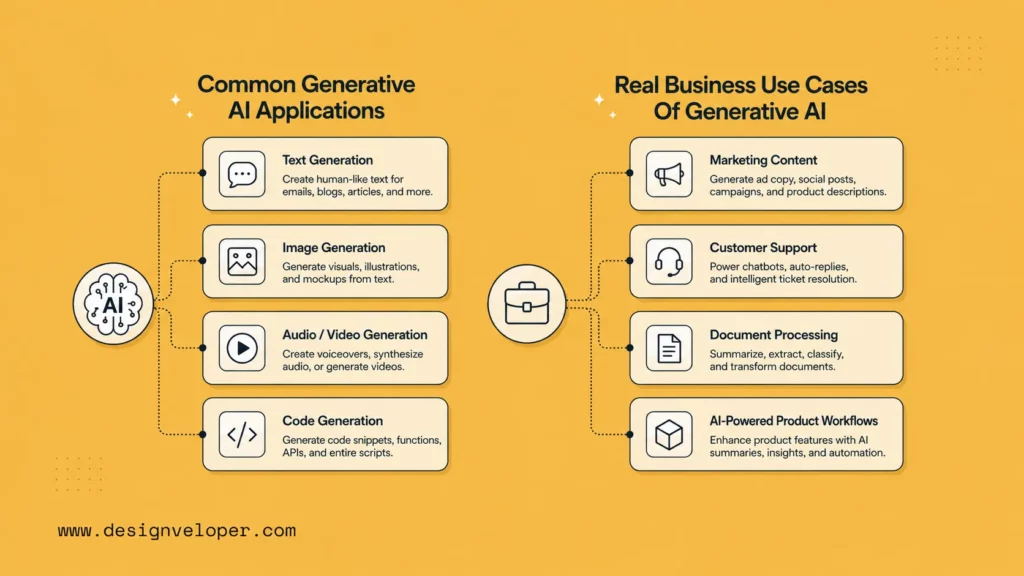
Text generation is the most familiar use case. Teams use generative AI to draft emails, reports, product descriptions, knowledge base articles, social posts, sales scripts, meeting summaries, and support responses. The strongest implementations use human review and clear brand guidelines instead of publishing raw outputs directly.
Image Generation
Image generation helps creative teams explore visual directions faster. It can support campaign concepts, mood boards, storyboards, product visuals, and design ideation. However, businesses should treat generated visuals as part of a professional creative process, not a substitute for design judgment, legal review, or brand governance.
Video And Audio Generation
Video and audio generation can help create voiceovers, training content, localization assets, product explainers, and synthetic media. These tools can reduce production time, but they also raise important questions about consent, authenticity, disclosure, and quality control.
Code Generation
Code generation tools can suggest functions, write tests, explain existing code, convert code between languages, and help developers navigate unfamiliar systems. They are most useful when paired with experienced engineering review, automated testing, security checks, and clear architecture standards. For a broader implementation view, see how AI software development changes product delivery.
Real Business Use Cases Of Generative AI
Generative AI use cases become valuable when they improve a measurable business workflow. The right implementation can shorten turnaround time, reduce manual effort, improve customer experience, and help teams manage more information without adding the same level of operational overhead.
Marketing And Content Automation
Marketing teams can use generative AI to draft campaign ideas, content briefs, ad variations, email sequences, landing page copy, and audience-specific messaging. The best systems keep strategy, editorial review, and brand voice under human control while using AI to accelerate first drafts and variations.
Customer Support And AI Assistants
Customer support is one of the clearest business applications. AI assistants can answer common questions, route requests, summarize conversation history, recommend next actions, and help agents respond faster. Designveloper has applied these capabilities in AI assistant products where conversational actions, OCR extraction, workflow support, and personalized assistant behaviors improve the user experience without exposing internal project names or proprietary details.
Document Processing And Knowledge Management
Generative AI is highly useful for document-heavy industries. It can summarize long files, extract clauses, compare versions, search document collections, redact sensitive information, and generate agreement drafts from approved templates. In an AI-powered document intelligence platform, these capabilities can turn static files into searchable, conversational, action-ready knowledge.
AI-Powered Product And Workflow Experiences
Many businesses do not need a standalone AI product. They need AI embedded into an existing SaaS platform, internal tool, or customer workflow. Examples include a finance platform that explains anomalies, a healthcare tool that summarizes notes, a property system that drafts reports, or a project management platform that turns meeting notes into tasks. This is where custom software teams can connect models to product logic, permissions, data pipelines, and user experience design.
Why Businesses Invest In Generative AI
Businesses invest in generative AI because it can improve how people work with information. It is not only a content tool. It is a productivity layer that can sit inside operations, customer service, product features, engineering, analytics, and decision support.
Faster Content And Workflow Execution
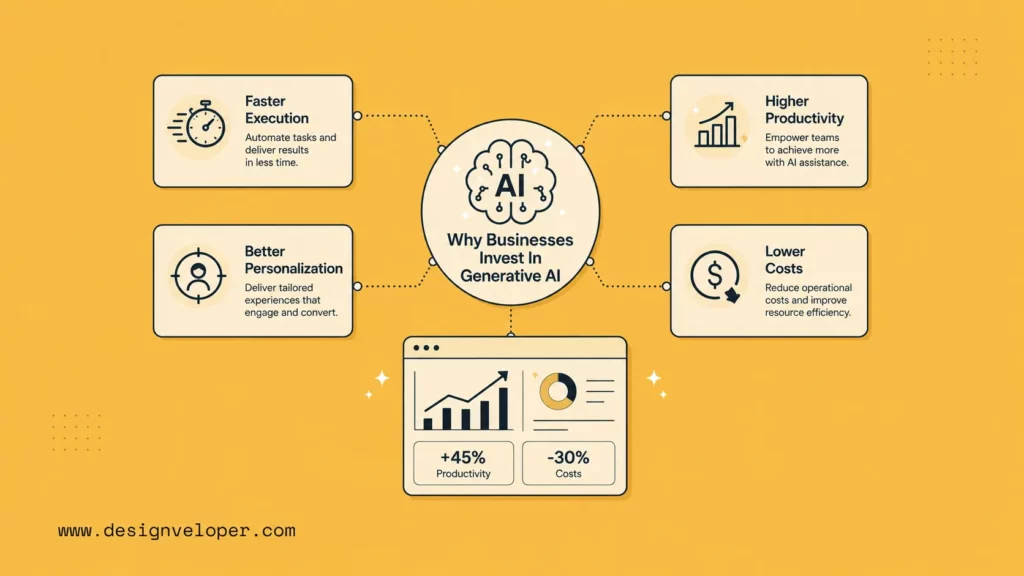
Generative AI can reduce the time between a request and a usable draft. A support response, summary, report outline, code snippet, or contract draft can appear in seconds. That does not remove review, but it does reduce blank-page time and repetitive preparation work.
Improved Productivity And Scalability
When implemented carefully, generative AI helps teams handle more tasks without scaling headcount at the same pace. A single support agent can review AI-suggested responses. A legal team can search and summarize more documents. A product team can test more content variations. A development team can move faster through boilerplate and documentation.
Better Personalization And Customer Experience
Generative AI can adapt responses, recommendations, explanations, and content to a user’s context. This helps companies deliver more relevant experiences, especially in customer support, education, onboarding, e-commerce, and SaaS products.
Reduced Operational Costs
Cost reduction usually comes from automating repetitive work, shortening cycle times, and reducing manual handoffs. However, responsible businesses also budget for model evaluation, security, monitoring, compliance, and ongoing improvement, using governance references such as NIST AI RMF and OWASP LLM Top 10. Generative AI is not free magic; it is a system that needs product thinking and operational ownership.
Limitations And Challenges Of Generative AI
Generative AI has real benefits, but it also has clear limitations. IBM highlights generative AI risks such as hallucinations, inconsistent outputs, bias, lack of explainability, security concerns, privacy issues, intellectual property concerns, and deepfakes. These risks do not mean businesses should avoid the technology. They mean businesses should implement it with guardrails.
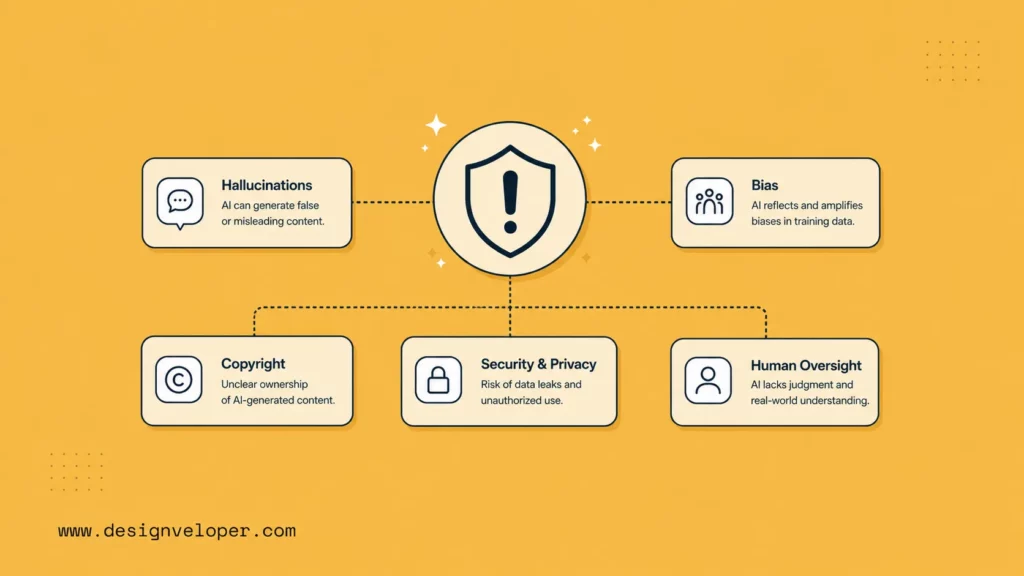
- Hallucinations and inaccurate outputs: Models can generate confident answers that are wrong. High-risk use cases need retrieval, validation, citations, and human review; the guide to AI hallucinations explains those safeguards.
- Data bias: Models can reflect bias in training data or feedback loops. Teams need representative data, evaluation, monitoring, and escalation paths.
- Copyright concerns: Generated text, images, and code can create licensing questions. Companies should define policies for training data, third-party tools, and public outputs.
- Security and privacy: Sensitive company or customer data should not be sent into tools without proper agreements, access controls, and data handling rules.
- Why human oversight still matters: AI can accelerate work, but people remain responsible for judgment, ethics, business context, and final decisions.
Explore more:
- Chatbot Vs. Conversational AI: Key Differences and Complete Guide
- AI Agent Vs. Chatbot: Key Differences & Which One Do You Need?
Generative AI Vs. Traditional AI: Key Differences
Generative AI vs traditional AI is a useful comparison because both belong to the wider AI field, but they often solve different problems. Traditional AI is commonly used to classify, predict, detect, recommend, optimize, or automate a decision. Generative AI creates new outputs such as language, images, code, summaries, and designs.
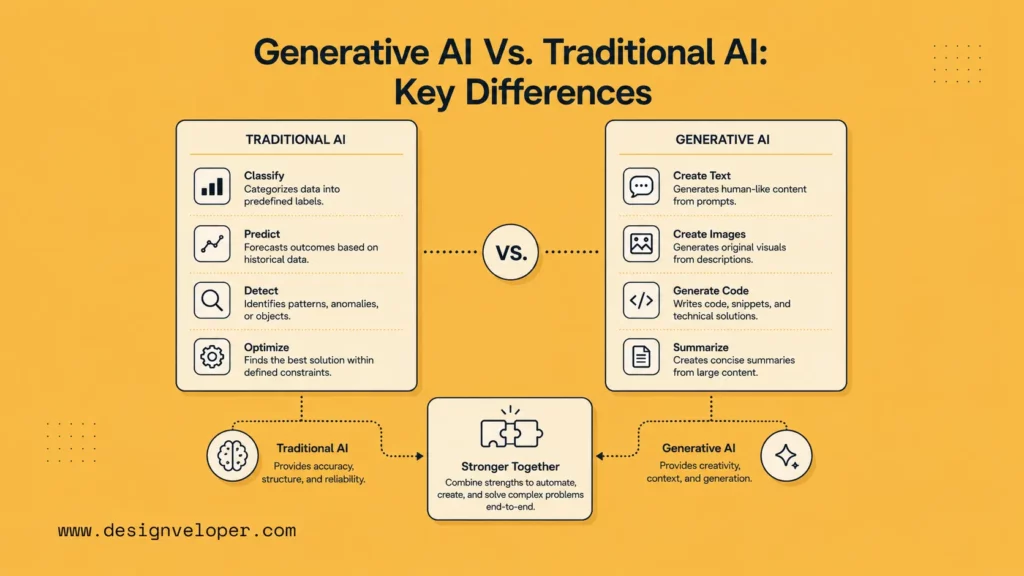
For example, a traditional AI fraud system may flag a transaction as suspicious. A generative AI system may explain the reason in natural language, draft a customer message, or summarize related account activity for an analyst. A traditional recommendation engine may suggest the next product. A generative AI assistant may explain why the product fits the customer’s goals and generate personalized onboarding content.
In practice, the two approaches often work together. A mature AI product may use predictive models for scoring, retrieval systems for knowledge, rules for compliance, and generative AI for natural language interaction. The goal is not to choose one category for every problem. The goal is to design the right AI system for the workflow.
How Businesses Should Start With Generative AI
Implementation evidence: Businesses should start with narrow workflows because McKinsey’s 2025 survey shows many companies remain in experimentation or piloting instead of full enterprise scaling. The safest path is to connect generative AI to one measurable process, define review points, use current vendor documentation for model capabilities, and expand only after the workflow is reliable.
The safest way to start with generative AI is to focus on a specific workflow, not a vague ambition. A business should ask where employees repeatedly read, write, summarize, search, transform, or explain information. Then it should evaluate risk, available data, user needs, and measurable outcomes.
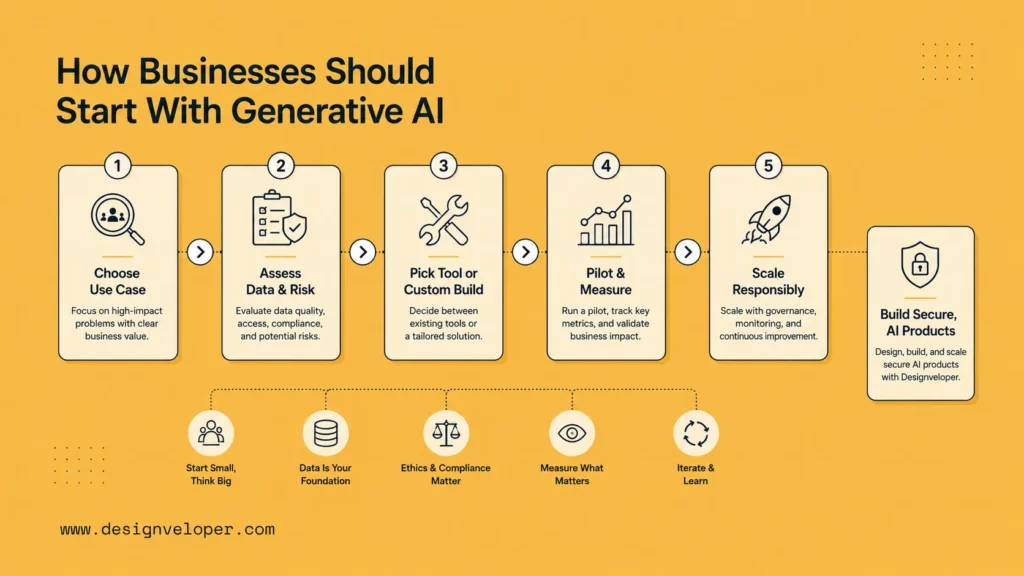
Choose High-Value, Low-Risk Use Cases
Early projects should create visible value without exposing the company to unnecessary risk. Internal knowledge search, support draft assistance, document summarization, content ideation, and workflow automation are often better first steps than fully autonomous decision-making in regulated areas.
Off-The-Shelf Tools Vs Custom AI Solutions
Off-the-shelf tools are useful when the workflow is generic, data sensitivity is low, and integration needs are simple. Custom AI solutions make more sense when the model must connect to proprietary data, follow domain-specific rules, support complex permissions, or become part of a product experience. Many companies eventually use both: general tools for everyday productivity and custom systems for core workflows.
Where Designveloper Fits
Designveloper helps businesses design and build AI-powered software that fits real product and operational needs. That may include AI assistants, document chatbots, OCR workflows, summarization systems, agreement generation, personalized assistant behaviors, or embedded AI features for SaaS products. The important part is not adding AI for novelty. It is choosing the right workflow, designing a useful user experience, and building the technical foundation securely.
FAQs About Generative AI
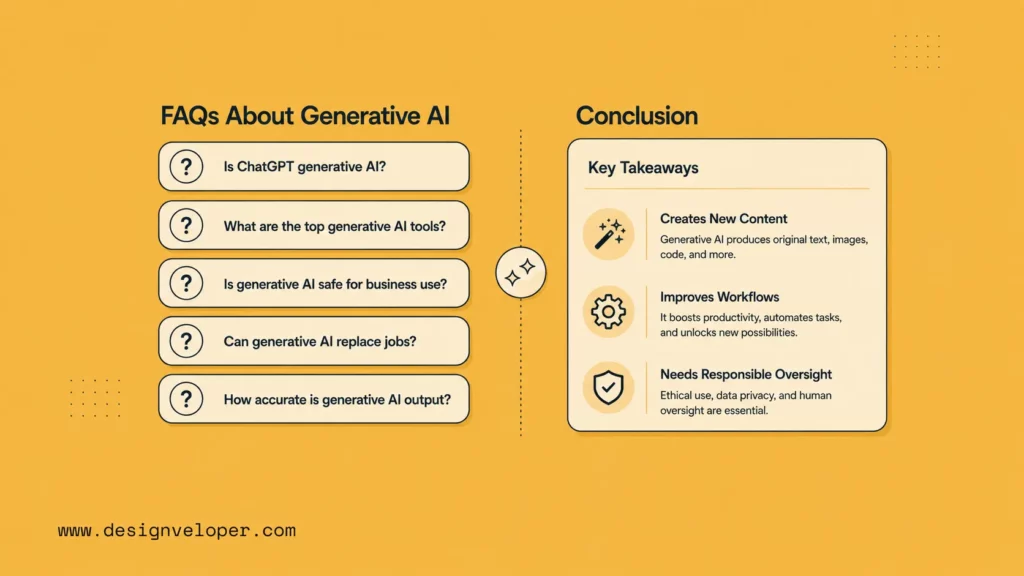
Is ChatGPT A Generative AI?
Yes. ChatGPT is a generative AI application because it can create new text responses, explanations, summaries, code, and other language-based outputs from user prompts.
What Are The Top 3 Generative AI Tools?
The answer depends on the task, but common categories include conversational AI tools such as ChatGPT or Microsoft Copilot, image generation tools such as Adobe Firefly or Stable Diffusion-based systems, and developer assistants such as GitHub Copilot or Amazon Q Developer. Businesses should choose tools based on security, integration, quality, and workflow fit.
How Is Generative AI Different From Machine Learning?
Machine learning is the broader method of training systems to learn patterns from data. Generative AI is a specific type of AI, often built with machine learning, that creates new outputs such as text, images, code, audio, or video.
What Is The Difference Between AI And Generative AI?
AI is the broad field of making machines perform tasks that normally require human intelligence. Generative AI is a subset of AI focused on producing new content or structured outputs.
Can Generative AI Replace Human Jobs?
Generative AI can automate parts of many jobs, especially repetitive drafting, searching, summarizing, and formatting tasks. It is more realistic to see it as a tool that changes workflows and skill requirements. Human judgment, strategy, empathy, accountability, and domain expertise remain essential.
Is Generative AI Safe For Businesses?
Generative AI can be safe for businesses when implemented with proper data controls, security reviews, human oversight, testing, monitoring, and clear policies. It becomes risky when teams use public tools carelessly with sensitive data or rely on outputs without validation.
How Much Does Generative AI Cost To Implement?
Costs vary widely. A simple off-the-shelf tool may only require subscriptions and training. A custom AI product may require discovery, data preparation, model selection, integrations, security work, user interface design, testing, deployment, and ongoing monitoring. The right budget depends on the workflow, risk level, data complexity, and expected business value.
Conclusion
So, what is generative AI? It is AI that can create new content, code, summaries, designs, and workflow outputs from data, prompts, and context. It works through trained models that learn patterns and generate useful responses when guided by the right instructions and systems.
For businesses, the real impact is not limited to faster content creation. Generative AI can improve customer support, document processing, knowledge management, product experiences, software development, and internal operations. At the same time, it requires responsible implementation because hallucinations, bias, privacy, security, copyright, and oversight all matter.
The companies that benefit most will not be the ones that chase every new tool. They will be the ones that identify practical use cases, connect AI to trusted data, design useful workflows, and keep humans in control of important decisions.
If your organization is exploring generative AI examples, business use cases, or custom AI solutions, Designveloper can help turn the concept into secure, scalable, and business-ready software. Our team supports AI product discovery, workflow mapping, AI chatbot integration, document intelligence, custom software development, testing, deployment, and post-launch improvement so the final system works inside real business operations.
To move from experimentation to a practical implementation roadmap, contact Designveloper and discuss the workflow your team wants to improve with generative AI.
Also published on

Share post on










Related Articles


AI Agent Case Studies: 10 Real-World Examples Across Industries
AI Agent Case Studies: 10 Real-World Examples Across Industries Published October 21, 2026
How Will AI Affect Software Development? Complete Guide In 2026
How Will AI Affect Software Development? Complete Guide In 2026 Published October 21, 2026
How To Build A RAG System: Step-By-Step (New Guide)
How To Build A RAG System: Step-By-Step (New Guide) Published October 19, 2026